
Question & Answer – Ambulance callouts and dispatch timeframes
Ms WEBB question to LEADER for the GOVERNMENT in the LEGISLATIVE COUNCIL, Ms RATTRAY
QUESTION:
Following a recent incident the afternoon of Friday the 24th of April this year, where a member of the public fell while visiting the Kingston Library resulting in that person being in extreme pain, feeling dizzy and nauseous, and later diagnosed as suffering a fractured humerus, but at the time were advised there would be an approximate seven hour wait for an ambulance, can the government please detail:
- The number of public ambulance and paramedics based in Kingston;
- The number of ambulance call-outs made in the Kingston area on a monthly basis since January this year;
- The average time taken between the initial call requiring an ambulance be sent to the Kingston area, and the dispatch of an ambulance in response to that call, per month since January 2026;
- The state-wide average time taken between the initial call requiring an ambulance, and the dispatch of an ambulance in response to that call, per month since January 2026;
- The current departmental guidelines or policy regarding acceptable ambulance call-out wait times; and
- Whether taxis have been utilised to transport patients in response to calls for an ambulance made in the Kingston area, and if so, how many times have taxis been used for that purpose since January this year?
ANSWER
1. There is currently one rostered ambulance located at the Kingston Ambulance Station that is continually staffed by two paramedics 24/7.
A change management process is currently underway with unions so that we can add a second ambulance crew during peak demand periods. In addition, due to the expected growth in the Kingborough region, construction is underway at the Station that will see garages built to house a further two ambulance vehicles.
2. Between January 2026 and April 2026, an average of 372 ambulance dispatches per month arrived on scene at incidents within the Kingston response area.

3. Between January and April 2026, the median time from a Triple Zero call to ambulance dispatch (first resource mobilisation) to the Kingston area was 6.3 minutes. The median indicates that around 50% of ambulances are dispatched within this time.
Ambulance Tasmania uses the median rather than the average, as it is less affected by extreme values and provides a more accurate reflection of typical performance. This metric aligns with Report on Government Services (RoGS) reporting and methods in other jurisdictions.
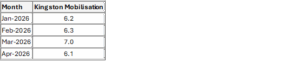
4. Between January 2026 and April 2026, the state-wide median time from a Triple Zero call to ambulance dispatch (first resource mobilisation) was 6.3 minutes, covering both rural and urban responses. This means that approximately 50% of ambulances are dispatched within 6.3 minutes.
5. Ambulance response time targets are aligned with national performance standards and subsequently benchmarked against other Australian ambulance services.
Ambulance Tasmania’s Urban and Rural response time metrics are drawn from the Tasmanian Health Service Plan 2025-26 under Strategic Priority 2 – Providing high quality and safe patient centred care.
The KPIs are comparative to how other ambulance jurisdictions measure and report on RoGS data. Most jurisdictions separate how response times are measured within their capital cities in comparison to areas with more dispersed populations. Some jurisdictions only report on capital city or urban response times. KPIs undergo annual review to confirm their relevance and effectiveness in supporting community services.
|
KPI Number |
Area |
Key Performance Indicator |
Target |
|
SP2-3 |
Ambulance Tasmania |
Urban areas – median emergency response time |
Less than or equal to 12 minutes |
Ambulance Tasmania strives for continuous performance improvement and works to identify new initiatives that aim to positively influence emergency response times and meet the needs of the Tasmanian community. These initiatives include recruitment to frontline roles, roster review and reform, infrastructure enhancements, and the development and strengthening of new and existing medical referral pathways.
6. Between January 2026 and April 2026, there were seven cases in the Kingston suburb where Secondary Triage clinicians assessed that a taxi was the most appropriate response.
a. All requests for ambulance services are triaged and prioritised based on urgency and the information available. Wait times are actively monitored, and patients may receive callbacks or be referred to alternative services where assessed as clinically appropriate.
b. Secondary Triage is one such service, which may identify safe alternative care pathways or transport options if clinically safe and appropriate to do so. This approach is consistent with other ambulance jurisdictions and importantly, is done in consultation with the patient and decided by the clinician.
